

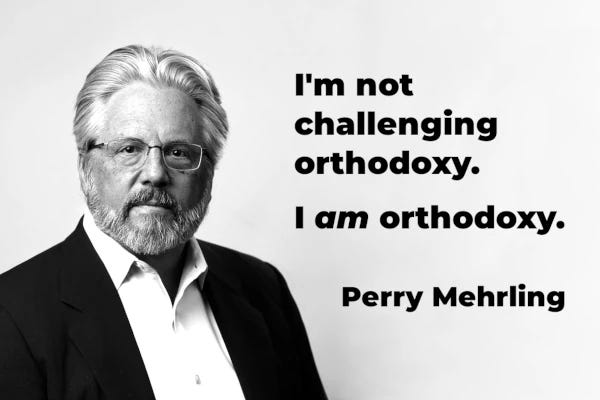
Original photo by Boston University
Last week, Perry died.
Perry Mehrling understood money, banking, and finance like no one else. He could make profound insights seem like common sense. And he was so good at sounding obvious that even those who appreciated his pedagogy often failed to recognize how subversive his ideas were.
He once told me he liked to present just the “tip of the iceberg.” If he tried to explain too much at once, people would tune out. But giving just a taste could inspire his students to discover the rest of the iceberg for themselves. Or, at the very least, they would tune in for more.
He wrote short books, not long books. “People don’t finish reading long books,” he would say. He wanted readers to finish his books.
His writing was deliberate and concise, but speaking is where he truly shined. To see Perry at his best, watch his 2012 MOOC lectures.
He sometimes spoke of implanting memes or “mind worms” in people’s heads.
“Liquidity kills you quick.”
“All banking is a swap of IOUs.”
“Solvency is accounting fiction. Liquidity is market fact.”
When I first met Perry, I told him he was my favorite economist. He said, “You must have taken the MOOC. People who take the MOOC feel like they know me.”
Do I know Perry? Maybe. I know he saw himself as a scientist, discovering and describing something real about the world.
Clip Length 40 seconds (Mehrling 2025, 57:14—57:54)
I think this is the normal natural language of bankers. So maybe [I’m] a heretic inside academia, but I want to say, “You guys, you’re the ones who are the heretics. You’re denying reality right in front of you.” And so I do not want to call myself somebody who’s somehow challenging orthodoxy. I’m not challenging orthodoxy. I am orthodoxy. I am orthodoxy. I’m just an orthodoxy outside of academia. I’m claiming orthodoxy.
(Mehrling 2025, 57:19)
Perry’s magnum opus is those 2012 lectures. But that’s only because he died.
His half-finished next book was to synthesize his monetary theory in a way that would be impossible for the discipline of economics to ignore.
I think most of the thinking is done. But putting it together is, itself, a hard work — and will take time. And I think once it’s put together, it will be easier for other people to learn it. Because, at the moment, the reason it feels hard to learn is because the only place it all exists is in [my head]. It doesn’t all exist on paper. It’s little bits of it that exist on paper, at the moment.
(Mehrling 2025, 1:12:20)
Do we want Perry to be remembered merely as a brilliant teacher with an unmatched intuition for money and banking? Or do we want him to be remembered as the father of monetary economics?
Perry Mehrling wasn’t done. He isn’t done. Those little bits are ready to be collected and pieced together. The rest of the iceberg is waiting to be discovered.
References
Mehrling, Perry. 2012. Economics of Money and Banking. Online course. Coursera. Accessed 2015–2026. https://www.coursera.org/learn/money-banking
Mehrling, Perry. 2025. A Money View of (Monetary) Heterodoxy, recorded January 9, 2025. Video, 1:38:47.